Territory
The World
Territory
Nations
◆Akoros
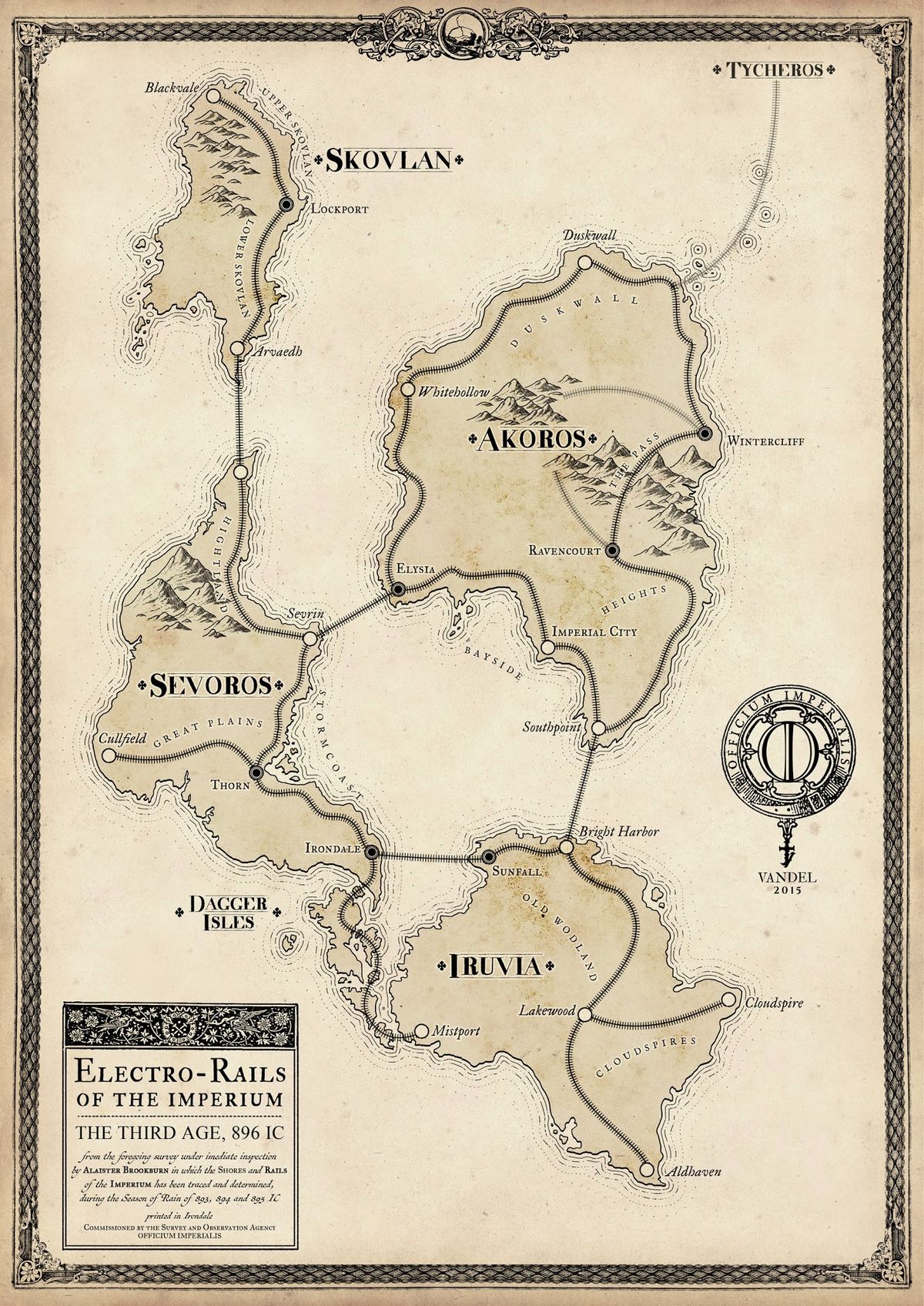
Akoros is the largest and most industrialized land in the Imperium, and is home to the capital city as well as Doskvol itself. They’re known as a diverse conglomeration of cultures that have grown together in close proximity for centuries. A land of dark, petrified forests and rocky hills. The rich coastal cities get their wealth from leviathan hunting and from mining colonies deep inland.
◆Skovlan
A ragged land of cold mountains and rough tundra. Skovlan was the last holdout against Imperial control, and fell during the 36-year-long Unity War (which ended only a few years ago). Many Skovlander refugees who lost their homes and jobs in the destruction of the war have come to Doskvol seeking new opportunities.
◆Severos
A land of windswept plains, covered in dark scrub and thorny growths. Outside the Imperial cities on the coast, some native Serverosi still live as scavengers, roving the death-lands on ghost-hunting mounts. Outside the few Imperial settlements, most Severosi live in small communities scattered across the blasted deathlands, surviving within the ruins of ancient arcane fortresses which still repel spirits.
◆Tycheros
A far off land, disconnected from the Empire. People say the Tycherosi (rudely called “Strangers”) have demon blood in their lineage. It’s a semi-mythical place, far away beyond the northern Void Sea.
◆Iruvia
A land of black deserts, obsidian mountains, and raging volcanoes. Some say that positions of power are openly held by demons in Iruvia. Their wealth is in large part due to the vast array of artisans that make their homes within Iruvia’s sprawling cities.
◆The Dagger Isles
A tropical archipelago covered in dense jungle growth; now turned dark and twisted from the strange magic of the cataclysm. People there often grow up on ships and travel a lot before settling down. Some say that the people there live without lightning barriers. How do they manage that?
Territory
Districts of Duskvol
▲Six Towers
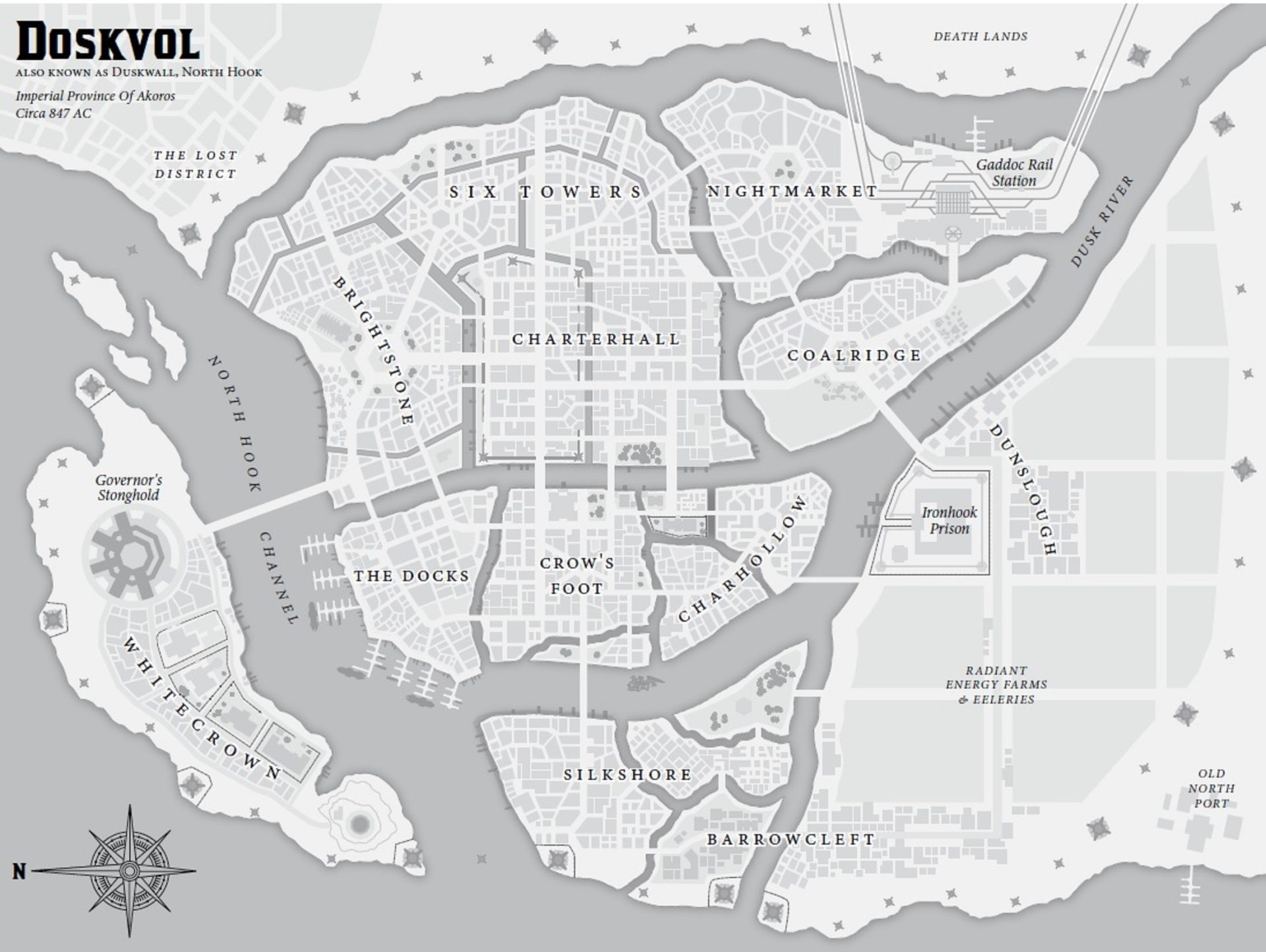
This once prestigious district has faded over the centuries into a pale shadow itself. The eponymous six towers were originally the grand residences of Doskvol’s first noble families. All but two (Bowmore House and Rowan House) have been sold off and converted into cheap apartments or fallen into ruin and abandoned. The district has an empty, haunted feel, with many sprawling old buildings dark without power, broad stone streets cracked and buckled, and the fires of squatters crackling from overgrown lots.
▲Charterhall
Charterhall is the site of the first major construction in the city, in the days before the Cataclysm. The old wall upon which was built the first lightning barrier in the Empire still stands in partial ruin around the district. The area is now home to the civic offices of the government including the courts, licensing and taxation offices, banks, and records archives. City officials and students at Charterhall University live here, along with the captains of Imperial industry who prefer to reside within sight of their fortunes.
▲Whitecrown
Whitecrown sits atop a grand peak on the island across North Hook channel from the city proper. From this lofty height, the Lord Governor’s stronghold oversees all, flanked by the grand estates of the most powerful nobility and the extravagantly appointed campus of Doskvol Academy. Whitecrown is a rich and rarefied world unto itself – most of Doskvol’s citizens live out their entire lives in the city without ever once crossing the bridge to the glittering spires of wealth and power there.
▲Nightmarket
Nightmarket is a district dominated by commerce. Situated near Gaddoc Rail Station, Nightmarket receives the bulk of salable goods from the cargo trains that travel across the Imperium, bringing the exotic and rare to Duskwall. The citizens that call Nightmarket home constitute a new class of “elites”: wealthy people who are not of noble descent but nevertheless claim land, status, and power without titles. The district has been taken over by new construction, introducing lavish private townhouses with all of the modern advances for those that can afford them.
▲Silkshore
Criss-crossed by dozens of narrow canals, Silkshore is a district best navigated by gondola, as most visitors to this “red lamp district” do. The brothels, vice dens, food stalls, and exotic shops all perch at the waterside, ready to satisfy the appetites of their clientele, no questions asked. Silkshore is a place of public indulgence and private indelicacy, catering to every pleasure imaginable – as well as some that strain the bounds of fantasy.
▲Coalridge
Coalridge is home to most of the machinists, industrial laborers, and factories of the city. It’s cramped, soot-choked, and loud—spewing dense clouds of black smoke, showers of sparks, and burning cinders. The old elevated train lines that once hauled coal now carry heavy equipment and raw materials to and from Gaddoc Station, though many of the ancient tracks and cars have been abandoned to squatters who’ve converted them into makeshift homes.
▲Crow's Foot
Crow’s Foot is a crossroads, merging many qualities of its neighboring districts: the illicit vices of Silkshore, the labor and trade of the Docks, the poverty of Charhollow, and the classic architecture of Charterhall. The district is a patchwork, both held together and threatened to be torn apart by the menagerie of competing street gangs and Bluecoat squads that claim every avenue and corner as territory in an endless turf war.
▲Dunslough
Dunslough is the site of Ironhook Prison and its labor camp. The ghetto surrounding it was originally a neighborhood for families of prisoners, but over the years, extreme poverty and neglect have worn it down into a sodden ruin. A vicious cycle plays out here: crime driven by desperation, then arrest, incarceration, and release back to Dunslough – giving Ironhook an endless supply of laborers to exploit.
▲Barrowcleft
Barrowcleft is the home to the laborers and overseers of the Ministry of Preservation who attend the radiant energy farms of Doskvol. It is a dusty, rural district, with simple wooden buildings of only one or two stories and wide dirt roads to accommodate large cargo wagons. The farmers of Barrowcleft are organized into tight-knit family-based clans that are proud of their vital role in the city’s welfare and hold themselves apart from the “city folk” across the river. Outsiders are welcome here for honest trade, but are met with a cold suspicion otherwise.
▲The Docks
The docks of Doskvol are ancient, going back to the days before the cataclysm, when the area was a colony town of the old Skov kingdom. Today, some commerce has shifted to the new electro-rail lines of the Imperium, but the docks are still bustling with cargo haulers, fishing boats, and the prestigious leviathan hunter ships that provide the raw material that keeps the city running.
▲Brightstone
Brightstone is home to many of the wealthiest and most influential citizens of Doskvol. Its streets are broad and paved, under bright electric lights; its canals are sparkling and clean, with perfumed water; its houses are all of fine, pale marble blocks, rich timbers, and intricate ironworks. There are cultivated parks, lavish restaurants and cafes, and luxury shops. Street-side vendors are forbidden here, resulting in a serene, spacious atmosphere, punctuated by the occasional carriage or marching Bluecoat patrol.
▲Charhollow
This crowded district is home to the bulk of the workforce of the city: servants, dockers, sailors, stockyard and eelery workers, cabbies, and so on. It’s cheap, noisy, cramped, and sweltering from cookfires and hissing steam-pipes, but there’s a familial camaraderie among its residents that you won’t find anywhere else. The people of Charhollow are a true community, brought together by circumstance, but bound by ties of mutual support and care in stark contrast to the cutthroat ruthlessness that constitutes business as usual in the rest of the city.
Territory
Factions
Codex
The Calendar
The current year is 847 post-Cataclysm, though this can be denoted as "After Cataclysm" (AC) or "Imperial Era" (IE), depending on your local custom.
The Akorosi calendar divides each year into 6 months, each month into 10 weeks, and each week into 6 days, thus 60 days per month and 360 days per year. There are no standardized names for the days of the week; officially, people refer to them simply by number. In practice, though, districts have colloquial names that differ depending on local culture.
Across the city, the first day is broadly known as Marketday, though in Coalridge it's just as often called Restday, the day laborers are offered a day of rest (or lessened hours).
In Crow's Foot, the second day is Homeday, the day prisoner's are typically released.
Down at the Docks, the third day is Comission Day, when old superstition holds that new ships should be launched.
In Charterhall, the fourth day is Requiem, the day wills and testamets are prosecuted.
In Charhollow, the fifth day is known grimly as Dust Day, when food stores of the poor typically run thin.
In Brightstone, the sixth day is Carillon, the customary night for operas and symphonies to perform.
Doskvol keeps several holidays through its calendar year. Moontide falls on the last day of every month and is an informal holiday that honors a now forgotten sky deity (though it's mostly a excuse to drink). Arkenvorn, observed on the 44th day of the 4th month, honors the institution of the Spirit Wardens. Unison, or the 33rd day of the 5th month, marks - depending on who you ask - either the celebration or the cursing of the end of the Unity War with Skovlan. Gratitutde, on the 60th day of the 6th month, honors the Immortal Emperor's ascension to the throne and the salvation of the Shattered Isles, while doubling as a broader occasion for giving thanks. And, finally, Doskvorn, on the first day of the 1st month, serves as both a New Year's Day and a citywide birthday celebration for everyone in Doskvol.
Codex
Education & Academia
There is no standardized or public education in Doskvol; instead private institutions (concentrated mainly in Charterhall and Whitecrown) are the center of formal schooling. As a result, most people are loosely educated or entirely uneducated, and admission to these instutions relies on demonstrated competency (and wealth).
Professional titles vary by field. Physickers and medics simply go by "Doctor." Legal professionals split into Barristers and Magistrates. Philosophers follow the academic track of Bachelor, Master, and Doctor. Alchemists begin as Apprentices, then Journeymen, then Masters, though reaching Master status requires the alchemist to invent an entirely new alchemical creation.
Legal recognition hinges on formal education. Professionals who've gone through proper institutional training are recognized at the journeyman level or above, whereas informal craftsmen (like gang leeches or handymen) who never received formal education go legally uncorngized in their craft no matter how skilled they are.
Codex
Noble Families
Six noble families hold seats on Doskvol's City Council, each with its own domain of influence and it's own fading or flourishing fortunes.
The Bowmore Family, though somewhat in decline these days, built much of their standing on history; the had comissioned many of Doskvol's most prominent buildings and structures, and continue to reap social and financial capital from that legacy even as their fortunes elsewhere slip.
The Clellan Family has deeply entrenched itself in law enforcement, with many family members serving among the Bluecoats. The current scion of the family holds the position of chief comissioner.
The Dunvil Family owns the labor camp at Ironhook.
The Penderyn Family has built its reputation on academics (and more quietly, occultism).
The Rowan Family is closely tied to the Church of Ecstacy and embeds their influence in the city's spitiual and hedonistic institutions.
The Strangford Family commands the leviathan hunter fleet and has historically positioned itself at the center of whatever energy source dominates the Empire at any given time. They own a substantial number of factories across Charhollow and Coalridge, and formerly controlled the mines in Coalridge as well, though that particular holding has since passed out of their hands.
Codex
Fashion
None of the following are hard rules. Anyone can wear anything they like; this is meant as a general guide to how the everyday person tends to dress.
Broadly, Doskvol's fashion sits within the constraints of the late 19th to early 20th century, roughly spanning the 1860ss to 1940s (though different neighborhoods lean into different slides of that range). Hats in particular carry outsized importance across the city, and function as a visible marker of wealth.
District by district, the aesthetic shifts considerably.
Nightmarket leans into the 1880s-1900s Western European Fashion.
Charhollow and Coalridge both draw from early industrial American and English style with practical workday clothing suited to industrial labor.
Silkshore takes on a 1920s French flair.
Charterhall sits somewhere in Edwardian fashion, closer to WWI era.
Brightstone, fittingly, aims for high fashion, similar to Belle Époque Paris.
Crow's Foot follows Newsies-style New York industrial look.
The Docks lean toward a American industrial style, with lighter weight fabrics.
Barrowcleft falls somewhere between 1860s and 1910s mid-western American farming fashion.
Dunslough, in contrast, has no fashion to speak up, as the city's forgotten and destitute quarter.
Codex
Tattoo Culture
Tattoos across the Shattered Isles have varried social and cultural importance. Leviathan hunters, for instance, bear special tattoos that can only be legitimately earned by seeing a leviathan with one's own eyes.
Gang affiliation is similarly marked on the body, particularly in Crow's Foot, where affiliation is of grave importance. The placement and style of tattoo varies by gang, with the neck and hands/wrists the most common spot.
Ironhook prison tattoos certain inmates found guilty of severe offences such as spiritual and capital crimes.
On the other end of the spectrum, charmed tattoos exist as a form of protection. The Tycherosi maintain ritual tattoos as a part of their traditions, and Skovlan tattoos are used to mark life events and serve ritual, totemic purposes of their own.